SME Confidence Tracker Q1 2026
Disciplined ambition in a more volatile Irish economy

The SME Confidence Tracker Q1 2026 provides insight into how small and medium‑sized enterprises (SMEs) across Ireland are starting the year. Irish SMEs entered 2026 in a more complex and uncertain environment, shaped by renewed inflationary pressure and global volatility.
“Despite a more uncertain economic environment, confidence has held firm, with 83% of SMEs remaining optimistic about their prospects for 2026. That said, businesses are watching margins more closely and being more selective about investment decisions. Those that balance financial discipline with investment in productivity, capability and resilience will be best placed to navigate the remainder of 2026 and beyond.”
Mark O'Rourke, Managing Director at Bibby Financial Services Ireland
Key findings - What SME owners are telling us:
- 83% of SMEs are optimistic about 2026. Confidence is strongest among larger turnover businesses (€5m+)
- 81% report margins squeezed by rising costs, particularly among larger firms
- Operating costs are up 10% on average (across all sectors)
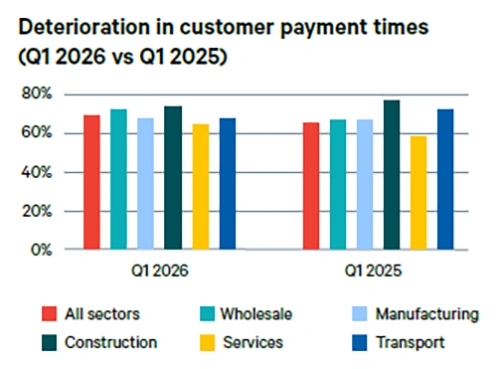
- 69% report a deterioration in invoice payment times (last wave: 62%)
- 57% say access has become more difficult in the past six months (up from 52% Q3 2025; 48% Q1 2025)
- 55% expect international trade to increase in the next 12 months, with optimism strongest among larger firms and Leinster based businesses
- 76% of business owners are exploring merger or acquisition opportunities for 2026, consistent with our research in Q4 2025 (60%)
Growth continues, within clearer boundaries
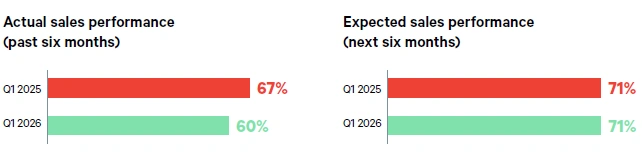
SMEs continue to see opportunity, even in a tougher operating context. Confidence is steady at 83%, underpinned by demand and sales momentum. 60% report increased sales over the past six months, while 71% expect sales growth in the six months ahead, particularly strong among larger and long-established businesses.
However, this is not “growth at any cost”. Many SMEs are prioritising a smaller number of opportunities they can deliver and fund, with less room for error and greater focus on getting the basis right.
Rising cost pressures are tightening margins
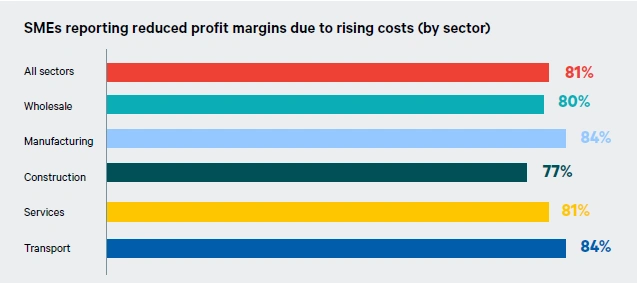
Cost pressures are now the dominant factor shaping profitability outcomes. Across SMEs, average operating costs increased by 10% over the past 12 months and 81% report margin compression. While many firms are responding by increasing prices (76% have raised prices due to cost pressures), a good portion of businesses cannot pass costs on fully, leaving margins exposed and reducing financial flexiblity.
Top cost challenges include:
- Inflation/ rising expenses (52%)
- Energy costs (51%)
As margins tighten, cashflow becomes more fragile: 22% cite cashflow constraints as a material issue, 27% say they don’t have the cashflow needed to grow, and 46% report increased funding requirements.
Cashflow and access to finance is getting harder, funding needs rising
With costs absorbing headroom, more SMEs are seeing funding requirements increase. As margins tighten, cashflow becomes more fragile: 22% cite cashflow constraints as a material issue, 27% say they don’t have the cashflow needed to grow, and 46% report increased funding requirements. In addition, a SMEs business are waiting longer to get paid which is putting pressure on cashflow.
Where funding is becoming more important and harder to access, 57% say access to finance has become more difficult in the past six months and 40% feel that traditional bank funding does not fully meet their needs.
Businesses are primarily seeking funding to support expansion and investment (40%) as well as day-to-day operations (35%), underlining the growing importance of finance as a strategic enabler.
Looking ahead, 71% expect sales to rise further, increasing to 78% among SMEs using external finance, highlighting the growing role of funding in supporting growth.
Investment intent: from expansion to capability and resilience
95% of SMEs are planning to invest, with average planned investment stands at €197k, with significant variation by business size and sector. What’s changing is where that investment goes. Rather than speculative expansion, SMEs are prioritising areas that strengthen the business over the long term, particularly staff development, digital capability and recruitment.
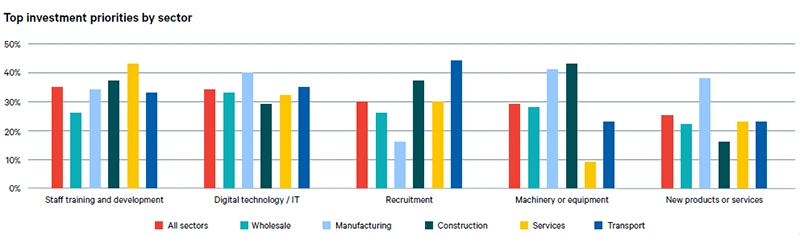
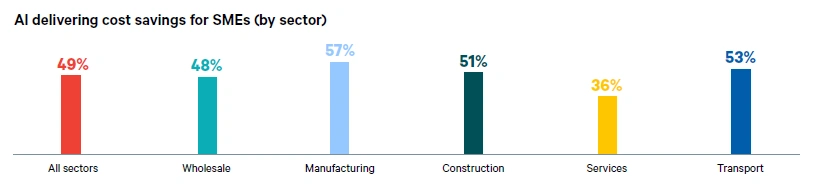
Digital and AI-led projects are playing a growing role in investment plans, even as caution rises elsewhere. 85% of SMEs have either adopted or plan to adopt AI tools within the next 12 months. Almost 50% report that AI has already reduced operating costs.